A Brand-New Flat Looks Perfect. Our Data Says Otherwise.
Possession day is emotional. Fresh paint, shining tiles, new fittings and the keys to a home you have waited years for. Most buyers walk through for 20 minutes, switch on a few lights, open a few taps and sign the handover letter.
We have been on the other side of that walkthrough in more than 1,300 homes since we started. Every defect our inspectors find is logged in our inspection app, with a category, a location, a photo and a severity. In the last 10 months alone, that adds up to more than 50,000 defects, one of the largest datasets of real, room-by-room defects in Indian residential projects.
So instead of telling you why a home inspection is needed, we decided to show you what the data says.
The short answer: "ready for possession" does not mean "free of defects". Across our inspections, defects show up in every part of a new home: floors, walls, doors, windows, plumbing, wiring and waterproofing. The question is not whether your flat has defects. It is which ones, and whether you find them before or after you move in.
Where Defects Hide in a New Apartment
We analysed a categorised set of 40,583 defects from our inspection records of the last 10 months. These are the defects our inspectors logged inside homes that builders had declared ready for handover. This is how they split by category:
Three things stand out:
- Flooring and painting alone account for 45% of all defects. These are the surfaces you see first, yet they are where we find the most problems.
- Carpentry, civil and housekeeping are almost equal, at about 11% each. Doors that do not lock, platforms with gaps and homes handed over unclean are routine findings, not exceptions.
- Electrical and dampness are a small share but the highest risk. We come back to this in the Defect Pyramid below.
If Your New Flat Had 100 Defects, This Is What They Would Look Like
Percentages can feel abstract. So imagine the defects in a typical new apartment as 100 squares:
Nearly a quarter of what we find is on the floor you will walk on every day. One in five is on the walls and ceilings you will be looking at. And at least one is a dampness or leakage problem quietly spreading behind a surface.
The Defect Pyramid: The Most Common Defects Are Not the Most Dangerous
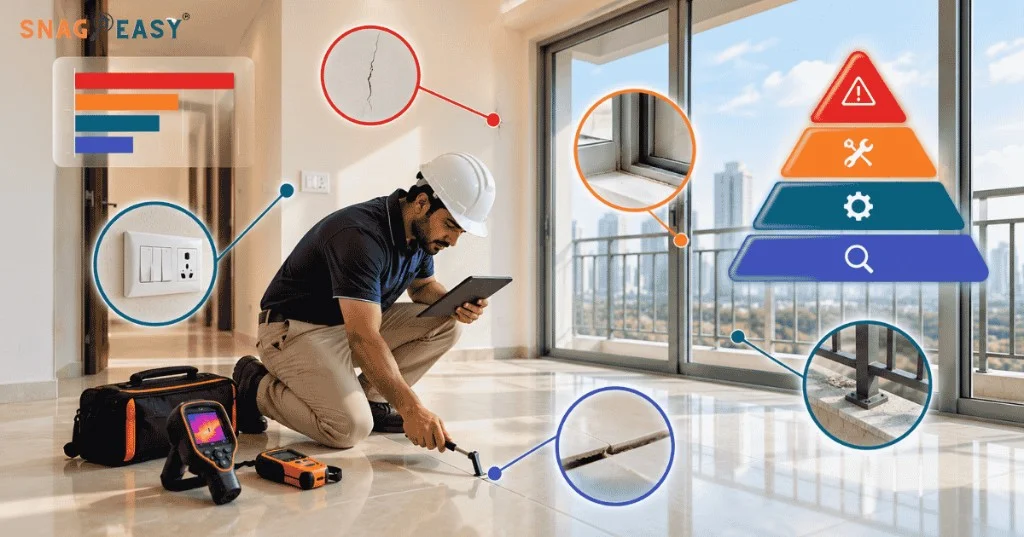
When we group the categories by what they mean for you as an owner, a clear pattern appears. We call it the Defect Pyramid:
Base of the pyramid (56%): Finish & Handover
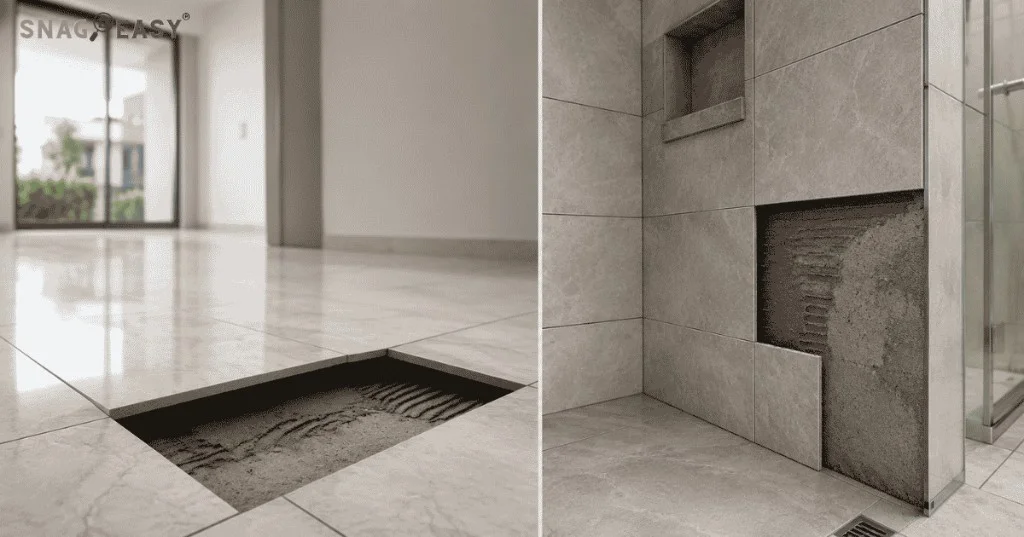
Chipped and hollow tiles, open grout, stains, unfinished paint, gaps above skirting and homes that still need cleaning. These are the defects buyers notice after moving in, when the sofa is on the floor and the wardrobe is against the wall. Before possession, the builder fixes them at no cost to you. After your interiors are done, fixing them means moving furniture, breaking tiles and matching a tile batch that may no longer be available.
Middle of the pyramid (37%): Build & Fit, Water & Openings
Door locks that do not work, doors that rattle, kitchen platforms with gaps, cracked granite, leaking fittings, missing sealant around basins and window frames, and faulty window locks. These defects affect how the home works every day. Many of them, especially missing sealant and platform gaps, are entry points for water.
Top of the pyramid (7%): Safety & Hidden
Faulty MCBs, loose DB panels, loose sockets and earthing issues. Dampness on walls, ceilings and at skirting level. Pipe and service-duct leakage. This is the smallest slice, but it is where a missed defect costs the most. Electrical faults are a shock and fire risk you cannot see. Dampness rarely stays where it starts. It moves behind tiles, into the next room's paint and into your new wardrobes.
The pyramid's lesson: the defects you are most likely to spot yourself (base) are the cheapest to fix. The defects you are least likely to spot (top) are the most expensive to ignore. A buyer's walkthrough covers the base. A professional inspection covers the whole pyramid.
The Most Common Defects We Find in Each Category
Below are the defects our inspectors log most often in each category, ranked from most to least frequent, using our standard defect library.
Flooring 24.1%
- Chipped off tiles
- Gap between skirting and floor or frame
- Grout filling required
- Hollow tiles
Hollow tiles and open grout let water in and lead to cracking. Read more in our tile hollowness guide.
Painting & Finishing 21.4%
- Stains on wall or ceiling
- Unfinished painting
- Gap or hole filling pending
- Cracks on wall or ceiling
Patchy paint and fresh putty can hide cracks and early moisture. Repainting after move-in is your cost and your inconvenience.
Carpentry 10.9%
- Door lock not working or damaged
- Door wobbling or rattling
- Chipped door or laminate
- Rusted hinges and hardware
A main door that does not lock properly is a security issue on day one.
Civil 10.7%
- Tile joint filling pending
- Crack on wall or ceiling
- Granite or marble chipped or cracked
- Gap below sink or kitchen platform
Platform and sink gaps send water straight into your kitchen cabinets.
Housekeeping 10.4%
- General cleaning required
- Stain marks to be cleaned
- Paint stains on fittings and tiles
- Deep cleaning required
Dust and paint splashes can hide scratches and chips underneath. A clean handover is part of a quality handover.
Plumbing 7.7%
- Gap around fixtures
- Water leakage at fittings
- Sealant missing around basin or sink
- Flush plate loose or misaligned
A slow drip today becomes dampness on your wall, or on your neighbour's ceiling.
Window & Railing 7.4%
- Silicon or sealant missing around window frame
- Faulty window lock
- Silicon missing between track and floor
- Rusted railing
Missing sealant is the classic monsoon leak. Railing defects are a child-safety concern.
Electrical 6.1%
- Switch not provided
- Wrong or misaligned switch plate
- Faulty MCB
- Loose DB panel or socket
Faulty MCBs and loose earthing cannot be seen. They need testing. See why electrical inspection matters.
Dampness & Leakage 1.4%
- Dampness on wall
- Dampness on ceiling
- Dampness at skirting level
- Leakage from pipe or service duct
The rarest category, but the one that spreads. Thermal inspection finds moisture before it shows.
New Flat Defects by City: Mumbai, Pune and Bangalore
Does it matter which city you buy in? We looked at the 386 homes we inspected in Jan 2026 – Oct 2026. Across all of them, a typical new home had 101 defects, and 29% of all defects were High severity. The pattern changes from city to city:
The only city where painting and finishing defects outnumber flooring. Expect unfinished paint, stains and gap filling to top your snag list.
Home inspection in Pune →Fewer defects per home than Pune or Bangalore, but nearly 1 in 3 is High severity. A lower count does not mean a lower risk.
Home inspection in Mumbai →The highest defect count and the highest share of High severity defects. Carpentry and civil work show up far more often than in other cities. Our Bangalore sample includes several villas and larger homes.
Home inspection in Bangalore →Every city has its own pattern, because builders, materials, labour and climate are different. But no city is defect-free. Whether you are taking possession in Mumbai, Pune or Bangalore, a typical new flat has dozens of defects that need to be fixed before you move in.
Want to Know What Is Hiding in Your Flat?
Our inspectors check all nine categories across 200+ checkpoints, with photos, severity and room-wise locations, ready to share with your builder.
Book Your Home Inspection →Why a Possession-Day Walkthrough Is Not Enough
Most of the defects above are not hard to fix. They are hard to find, especially for someone who is excited, short on time and seeing the home for the first time. Here is how a typical buyer walkthrough compares with a professional inspection:
| Area | Buyer walkthrough | SnagEasy inspection |
|---|---|---|
| Flooring | Looks at the tiles | Tap-tests tiles for hollowness, checks grout, gaps, chips and level |
| Walls & ceiling | Checks the paint colour | Checks finish, cracks, stains and moisture with a moisture meter |
| Electrical | Switches on a few lights | Tests every socket, MCB, earthing and DB panel with instruments |
| Plumbing | Opens a tap or two | Checks every fitting for flow, leakage, sealant and drainage |
| Doors & windows | Opens the main door | Checks locks, hinges, alignment, sealant, tracks and railings |
| Hidden dampness | Not visible | Thermal imaging to spot moisture behind surfaces |
| Documentation | Mental notes, a few phone photos | Room-wise report with photos, severity and standard notes, in 24 hours |
Timing Is Everything: Before Possession vs After Interiors
The same defect can cost you nothing or a lot. The difference is when it is found.
Found after interiors
Your costFurniture moved, wardrobes and kitchen units opened up, tiles broken and replaced, walls repainted. For a single area of hollow tiles, repair can cost ₹20,000 to over ₹1,00,000, plus weeks of disruption and arguments about who is responsible.
Found before possession
₹0 to youDocumented with photos, submitted to the builder and fixed as part of the handover. A re-inspection confirms the work was actually done.
Under RERA, builders are responsible for structural and workmanship defects reported within five years of possession. A professional, timestamped inspection report is the strongest evidence you can have, whether you raise defects at handover or later. Learn more about home inspection under RERA.
Your Pre-Possession Action Plan
- Book your inspection before you sign the possession letter. Once you have accepted the flat "as is", it is harder to get defects fixed.
- Ask for power and water to be connected. Electrical and plumbing can only be tested properly with live supply.
- Share the report with your builder in writing. A room-wise, photo-backed report removes any argument about what was found and where.
- Re-inspect after rectification. "Marked as closed" does not always mean fixed. Verify it before you start interiors.
- Only then start your interiors. Never build wardrobes or a modular kitchen over a defect that has not been fixed.
Final Thoughts
Every new home has a story the brochure does not tell. The 50,000+ defects we logged in just the last 10 months tell it plainly: about half of what goes wrong is on the floors and walls, about a third is in how the home works, and a small but serious share is hidden in the wiring and behind the walls.
None of this means your builder did a bad job. Construction is complex, timelines are tight and hundreds of flats are handed over at once. Defects are normal. Accepting them unknowingly should not be.
A professional home inspection turns possession day from a leap of faith into an informed decision. You know exactly what is wrong, the builder knows exactly what to fix, and you move into the home you actually paid for.
Related Resources
- 200+ Point Home Inspection Checklist
- Top Hidden Defects That Can Cost ₹50,000–₹1,00,000+
- Tile Hollowness: The Hidden Defect Behind Dampness
- Why Electrical Inspection Is Essential Before Possession
- Thermal Inspection: Find Moisture Before It Shows
- Professional Home Inspection Demo
Explore our city-specific services: Mumbai, Pune, Bangalore, Chennai and Lonavala.
A home inspection doesn't cost money. It saves money, protects your investment and helps ensure a truly defect-free possession.
👉 Book Your Home Inspection Today
SnagEasy is a registered trademark of N S Mountains LLP. Startup India recognised. Professional home inspection services across Mumbai, Navi Mumbai, Thane, Pune, Bangalore, Chennai and Lonavala.