Why Electrical Inspection Is Essential Before Taking Possession of a New or Resale Home
Every homebuyer checks the paint, the tiles, the view from the balcony. Almost nobody checks what is inside the walls.
Your home's electrical system — the wiring tucked behind plaster, the distribution board tucked in a corner, the earthing that nobody ever thinks about until something goes wrong — is invisible on a walkthrough. It looks fine whether it is fine or not. And that is exactly the problem.
Electrical defects are among the most dangerous and most expensive issues found during professional home inspections in India. They are also among the most commonly missed, both in new apartments and in resale properties.
This guide explains what electrical inspection actually covers, what the data from real inspections looks like, and why getting a professional electrical assessment before possession is one of the most important things a homebuyer can do.
What Is Electrical Inspection and Why Does It Matter?
An electrical inspection is a systematic, instrument-based assessment of every electrical component in a home — from the main distribution board (MDB) to individual sockets, switches, and earthing points across every room.
It is not a visual glance at the switchboard. It uses calibrated instruments — digital multimeters, voltage meters, earthing meters, clamp meters — to measure actual electrical parameters against the standards defined by IS 732 (Code of Practice for Electrical Wiring Installations), IS 3043 (Code of Practice for Earthing), and relevant IEC codes.
The reason it matters comes down to one uncomfortable fact: electrical defects in Indian homes are rarely obvious until something fails. A wire with incorrect insulation looks identical to a correct one. A socket with reversed polarity works normally for months before causing a shock. A geyser circuit rated at 16A when it should be 20A will function until the day it trips your MCB during morning peak load — or worse, causes a sustained hotspot in the wiring.
Professional electrical inspection makes these issues visible before possession, when the builder is still responsible for fixing them.
New Home vs Resale Home: The Electrical Risks Are Different
New Apartments: Construction Errors You Cannot See
A brand new home should have a flawless electrical system. In reality, the pressure of large-scale residential construction — tight possession deadlines, multiple contractors working across hundreds of units simultaneously — creates consistent opportunities for error.
The most common electrical defects found in newly constructed homes during SnagEasy inspections include:
- Undersized MCB ratings for high-load circuits. Geysers require a dedicated 20A circuit and MCB. It is not uncommon to find 16A MCBs on geyser circuits — a mismatch that causes nuisance tripping and, over time, heat stress on the wiring. This specific issue appeared in a recent SnagEasy inspection, where two geyser circuits were found running at 16A actual against a 20A standard — a clear deviation invisible without instrument testing.
- Missing or inadequate ELCB/RCCB protection in wet areas. Earth Leakage Circuit Breakers are a non-negotiable safety requirement in bathrooms, kitchens, and utility areas. Absence or incorrect installation of ELCBs in wet areas is one of the leading contributors to residential electrical shock incidents in India.
- Polarity errors at sockets. Live and neutral wires swapped at the socket level. The socket works normally — lights come on, devices charge — but the appliance remains energised even when switched off, creating a persistent shock risk.
- Loose connections at junction boxes. Wiring connections not properly terminated. These generate heat under load and are a fire risk over time.
- Non-functional outlets. Sockets or switches that simply do not work due to broken connections during installation.
- Improper earthing continuity. Earthing is the last line of defence against electrical shock. Missing or broken earthing continuity in circuits is a silent hazard that only shows up on measurement — or in an emergency.
Resale Homes: Ageing Systems and Hidden Modifications
In a resale property, the electrical system has years of wear, potential amateur modifications, and the accumulated decisions of previous owners. The risks are categorically different from a new home.
- Aged wiring. Electrical wiring has a functional lifespan. PVC insulation degrades over time, becomes brittle, and cracks — creating short circuit and fire risks. Older properties may still have aluminium wiring, which carries different thermal properties from the copper wiring required by modern IS standards.
- Unauthorised additional circuits. Previous owners may have added air conditioner points, modular kitchen appliances, or high-load equipment without proper circuit additions to the distribution board, overloading existing circuits.
- Corroded distribution boards and terminals. Moisture ingress over years causes terminal corrosion, which increases contact resistance and heat generation.
- Missing safety devices. ELCBs that were never installed, MCBs that have been replaced with incorrectly rated alternatives, earthing connections that have corroded to the point of discontinuity.
- Concealed wiring damage. Rodents, seepage behind walls, or drilling by previous renovation contractors can damage concealed wiring in ways that are invisible without thermal imaging.
In a resale transaction, unlike a builder handover, there is no warranty period to fall back on. Whatever condition the electrical system is in on the day of registration is the buyer's inherited responsibility.
What Does a Professional Electrical Inspection Actually Cover?
A structured SnagEasy electrical inspection evaluates five core areas of the property's electrical system.
1. Main Distribution Board (MDB/DB) Assessment
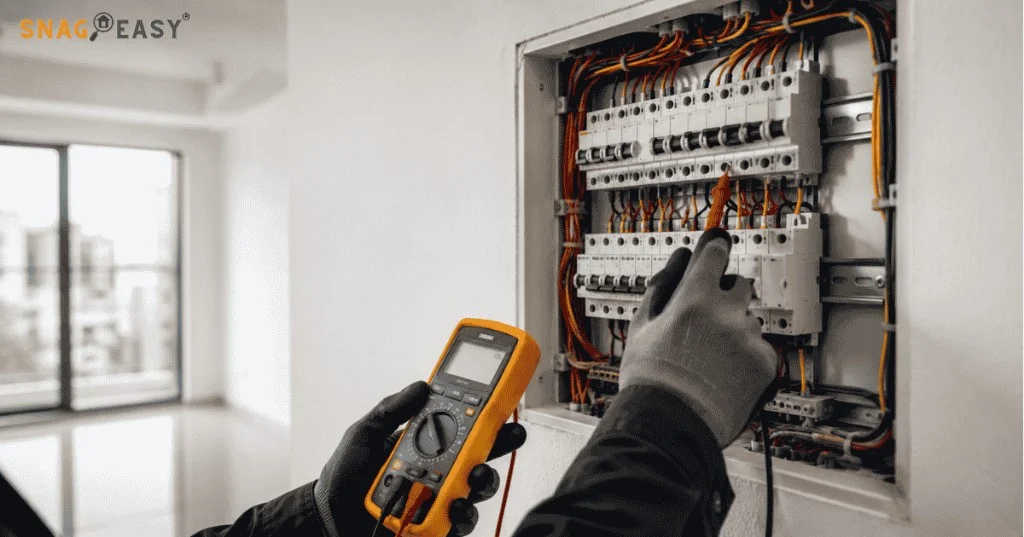
The distribution board is the electrical brain of the home. Every circuit originates here. The MDB inspection verifies that each circuit's MCB rating matches the load it is serving — a seemingly simple check that catches one of the most common installation errors.
A typical MDB assessment in a large apartment (4–5 BHK) evaluates 12 to 15 individual circuits, checking:
- Standard amp rating for each appliance or zone
- Actual installed MCB rating
- Correct labelling of each breaker
- Presence and correct rating of the main ELCB/RCCB at the panel level
- Physical condition of wiring terminations inside the board
In a recent SnagEasy inspection of a premium apartment, the MDB assessment revealed that two out of four geyser circuits had 16A MCBs installed against the required 20A standard. These circuits were running correctly in normal use — the deviation would only surface under full load conditions, causing nuisance tripping or wiring heat stress over time.
2. Phase Voltage Health Check
Voltage stability is fundamental to appliance safety and lifespan. A phase voltage health check measures:
- Earth-to-Neutral (E-N) voltage: must be 0–3V. Values above this indicate an earthing issue.
- Phase-to-Phase voltages (B-R, Y-B, R-Y): standard 415V ± 10%.
- Phase-to-Neutral voltages (B-N, Y-N, R-N): standard 230V ± 10%.
These readings are taken at the distribution board and at individual points across the home. In a recent SnagEasy inspection, the phase voltage check across nine measurement points returned readings between 414V and 416V for phase-to-phase and between 230V and 234V for phase-to-neutral — all within the Good to Excellent range. This structured documentation gives the buyer a verified baseline and confidence that the incoming supply and distribution are stable.
3. Component Quality Assessment
Not all electrical components are equal. The brands and grades of switches, MCBs, distribution board enclosures, and wiring determine the home's long-term safety and reliability. A component quality assessment documents:
- Switches: Brand and tier (e.g. Legrand, Anchor, Roma)
- MCBs: Brand and tier (e.g. Schneider, Havells, local unbranded)
- DB Box: Brand and material quality (e.g. L&T, Legrand, generic)
- Electrical Wiring: Brand, type, and insulation standard (e.g. Polycab, Finolex, unbranded)
Tier 1 premium brands represent a significant quality and safety premium over generic alternatives. For resale buyers discovering generic or unbranded components, it is grounds for price negotiation or upgrade before possession.
4. Socket and Switch Functionality Testing
Every individual socket, switch, and electrical point in the home is tested for live/neutral/earth connection presence and polarity, correct functioning, physical condition, and compliance with room-type requirements (e.g. ELCB-protected points in bathrooms). For a 3BHK apartment, this typically involves testing 60 to 90 individual electrical points across all rooms.
5. Earthing and ELCB Verification
Earthing continuity is tested for all circuits, distribution boards, and individual points using a calibrated earthing meter. ELCB functionality is tested by simulating a fault condition to verify that the breaker trips within the correct response time. In wet areas — bathrooms, kitchen, utility — ELCB/GFCI protection is mandatory. Missing or non-functional ELCBs in wet areas are classified as high-severity defects.
Why Electrical Defects Are Especially Dangerous to Ignore
Electrical defects sit in a different risk category from most snag report findings. A hollow tile or a paint variation is an aesthetic and financial issue. A faulty electrical installation is a safety risk — to life, and to property.
Residential electrical fires are a leading cause of property damage in India. Loose connections, overloaded circuits, and degraded wiring are among the primary causes. These are not random events — they are the eventual outcome of unresolved installation defects.
Electric shock incidents in residential settings most commonly involve either earthing failures or missing ELCB protection in wet areas. Both are directly identifiable and preventable through professional inspection.
The financial dimension is equally significant. Electrical defects detected before possession are the builder's responsibility to rectify under RERA. The same defects discovered after possession — after interiors are fitted, after walls are painted, after false ceilings are installed — become the homeowner's cost. In a premium apartment, rewiring a single circuit after possession can cost ₹15,000–₹40,000. Rewiring multiple circuits, or dealing with an ageing distribution board in a resale property, can run to several lakhs.
What the SnagEasy Electrical Inspection Report Includes
Every SnagEasy electrical inspection produces a structured, photo-documented report that includes:
- MDB/DB Assessment table — appliance by appliance comparison of standard amp ratings versus actual installed ratings, flagging any deviations.
- Phase Voltage Health Check table — measurement point by measurement point voltage readings with Good/Excellent status ratings.
- Component Quality Assessment — brand and tier documentation for switches, MCBs, DB box, and wiring.
- Socket and switch defect log — room-by-room listing of all non-functional, improperly wired, or physically defective electrical points with photographs.
- ELCB/earthing test results — location-specific earthing continuity readings and ELCB trip test outcomes.
- Severity classification — each defect is classified as High, Medium, or Low severity so the builder's team can prioritise rectification.
- Inspector verification and timestamp — the report carries the inspector's name, rank, and report generation timestamp, making it a formal document for builder communication and RERA submissions.
This report can be submitted directly to the builder's CRM team, establishing an official paper trail for rectification under RERA — which requires builders to address quality and workmanship defects within 5 years of possession.
Electrical Inspection: New Homes vs Resale — What to Prioritise
| Inspection Area | New Home Priority | Resale Home Priority |
|---|---|---|
| MDB / MCB rating check | High | High |
| Phase voltage health | Medium | High |
| ELCB / earthing verification | High | High |
| Component brand quality | Medium | High |
| Socket and switch testing | High | High |
| Wiring condition assessment | Medium | Very High |
| Concealed wiring thermal scan | Low | High |
For resale properties, SnagEasy recommends pairing the standard electrical inspection with a thermal inspection — infrared thermal imaging that can detect hotspots in concealed wiring and behind distribution boards without any dismantling or damage to the property.
What Happens After the Electrical Inspection?
For new apartments: The SnagEasy snag report is shared with the builder's CRM team along with the official possession email. Builders in India are generally responsive to structured, photograph-supported technical reports — particularly for items that fall under RERA quality obligations. Most builders schedule a site visit by their electrical contractor within 1–2 weeks to verify and begin rectification.
For resale properties: The inspection report forms the basis of negotiation with the seller. Documented electrical defects — especially high-severity items like missing ELCBs, earthing failures, or undersized MCBs — provide concrete, quantified grounds for price adjustment or a seller commitment to rectify before registration. Our guide on common hidden defects during home inspection covers the full range of issues that typically surface across both property types.
After rectification: SnagEasy offers re-inspection services to verify that reported defects have been correctly addressed before final possession. This is particularly important for electrical defects, where an incomplete or incorrect fix is as dangerous as no fix at all.
How Electrical Inspection Fits Into Complete Home Inspection
Electrical inspection is one component of a comprehensive home inspection — which simultaneously evaluates civil and structural condition, plumbing, flooring, carpentry, painting, dampness, and RERA carpet area verification across 200+ checkpoints.
The reason a complete home inspection matters for electrical safety specifically is that electrical defects often have a plumbing or structural context. Dampness behind walls degrades wiring insulation. Seepage into distribution board enclosures causes corrosion. Structural cracks can displace conduit runs. An inspection that only looks at electrical points without checking adjacent moisture levels may miss the underlying cause of an electrical issue it flags.
This is why SnagEasy inspectors work as a coordinated team across disciplines — electrical, civil, plumbing, and finishing — rather than treating each system in isolation.
Common Questions from Homebuyers
Do I need electrical inspection for a brand new flat?
Yes, absolutely. New flats have construction errors — MCB mismatches, polarity faults, non-functional sockets — at rates that regularly surprise first-time buyers. The advantage with a new flat is that the builder is responsible for fixing everything identified before possession.
The builder says everything is tested. Do I still need a third-party inspection?
Builder-side testing is internal quality control, not an independent verification. It operates under the same construction pressures that created the defects in the first place. Third-party inspection gives you an independent, documented assessment that is not subject to those pressures.
Can I inspect the electrical system myself?
A basic visual check — confirming switches work, sockets are functional — is possible without tools. But polarity errors, earthing failures, MCB rating mismatches, voltage deviations, and ELCB non-functionality require calibrated instruments and technical knowledge to identify correctly. These are the issues that matter most, and they are invisible without professional assessment.
What if the builder refuses to accept the report?
A well-structured, technically documented report from a professional inspection company is difficult to dismiss. Under RERA, builders are legally required to address quality and workmanship defects within 5 years of possession. Our reports are specifically structured to be builder-friendly and RERA-compliant, which is why they are accepted by reputed developers across Mumbai, Pune, and Bangalore.
How much does electrical inspection cost versus what it saves?
A full home inspection (which includes electrical inspection) starts at ₹6,000 for a 1BHK. Electrical rectification after possession — when access requires demolishing finished surfaces — can cost ₹30,000–₹1,50,000 or more. The inspection cost is typically recovered many times over in avoided post-possession repair work.
Book Your Electrical Inspection with SnagEasy
SnagEasy's certified electrical inspectors operate across Mumbai, Pune, Navi Mumbai, Thane, Bangalore, Chennai, and Lonavala. Every inspection produces a structured, photograph-supported snag report within 24 hours, ready for formal builder submission.
Whether you are weeks away from possession of a new apartment or about to sign the sale agreement on a resale property, an electrical inspection is the one step that gives you technical certainty about the system your family will depend on every day.
👉 Book your electrical inspection today
Related Resources
- Electrical Inspection Service — What We Check
- Complete Home Inspection in Mumbai
- Complete Home Inspection in Pune
- Complete Home Inspection in Bangalore
- Thermal Inspection — Detect Hidden Electrical Hotspots
- Home Inspection Checklist — 200+ Checkpoints
SnagEasy is a registered trademark of N S Mountains LLP. Professional home inspection services across Mumbai, Pune, Navi Mumbai, Thane, Bangalore, and Lonavala.