Comprehensive Home Inspection Checklist – A Complete Guide for Homebuyers
Buying a home is arguably the largest purchase most people make. A well-structured, tool-driven inspection before possession protects that investment. This article goes beyond a simple checklist — you will learn what inspectors look for, why each check matters, which tools are used, how to prioritise defects, and how to convert the snag report into action with your developer.
Inspection approach & why it matters
Professional inspections combine visual checks with instrumented tests (laser measurement, moisture meters, multimeters, thermal cameras, tile-hollow testers). The goal is to find defects that affect safety, performance, or long-term durability — and to document them clearly so builders can rectify them before you move in.
How inspectors categorize defects
Inspectors typically tag defects as:
- Critical — safety or structural risk that must be fixed before handover (e.g., exposed live wiring, major leak affecting slab)
- Moderate — affects usability or causes damage if left (e.g., persistent seepage, significant tile hollowness)
- Minor — cosmetic or easy-to-fix finishing issues (e.g., paint marks, small grout chips)
Room-by-room checklist (high level + why each check matters)
Doors
Why: security, insulation and smooth operation. We check frame plumb, gaps, locks, hinges, sill finishing and edge sealing. Misaligned doors cause noise, heat loss and wear on hardware.
Windows
Why: ventilation, waterproofing and sound insulation. Checks include glass condition, sealing, drainage holes, sliding action, and bead/silicone finishing. Poor sealing leads to water ingress and mould growth.
Flooring & Tiles
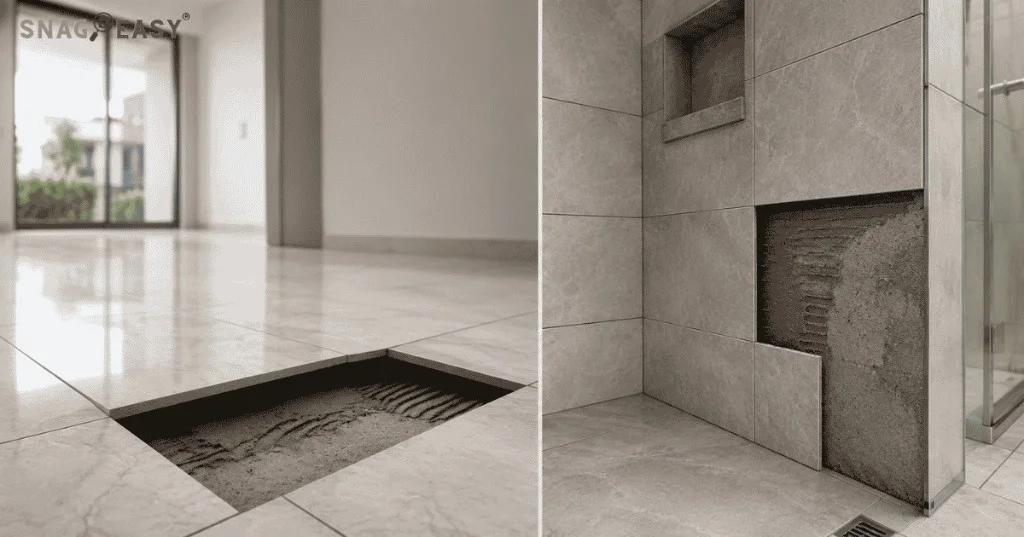
Why: longevity and safety. We test for tile hollowness with tapping, check level across rooms, inspect grout and edge finishing and verify slopes in wet areas. Hollow tiles break or pop later and uneven floors affect furniture and finishes.
Walls & Ceilings
Why: aesthetic and structural performance. Checks include cracks, plaster hollowness, paint finish, and straightness using spirit levels. Early detection of plaster or settlement cracks prevents future repairs.
Kitchen
Why: durability in wet/used areas. We inspect platform finish, sink slope & drainage, sealants, cabinet fixings and gas line sleeve and protection. Improper finishing leads to water logging and hardware failure.
Plumbing
Why: avoid seepage and hygiene problems. Tests include pressure checks, leak tests on fittings, drainage flow, trap seals (nahani trap), and visible service duct inspection. Undetected leaks cause costly waterproofing failures later.
Electrical
Why: safety and usability. Using multimeters and insulation testers we check socket polarity, live/neutral presence, MCB/RCCB operation, earthing continuity, DB wiring neatness and rated conductor sizes. Electrical hotspots, loose connections or missing earthing are major safety risks.
Dampness & Moisture
Why: long-term health and structure. Moisture meters and thermal imaging map hidden dampness behind plaster and tiles. Early damp detection prevents mould, peeling paint and structural deterioration.
RERA Carpet Area Verification
Why: financial correctness. We measure carpet area with laser distance meters room-by-room and compare to RERA-declared area — discrepancies can translate to monetary claims or adjustments.
Balcony & Safety
Why: fall protection and weather durability. We inspect rail height, anchorings, rust on brackets, and parapet stability. Balcony failures are serious safety issues and must be corrected promptly.
Tools commonly used in a professional inspection
- Thermal camera — to locate hidden moisture and electrical hotspots
- Digital moisture meter — numeric moisture readings for walls/tiles
- Laser distance measurer — carpet area and room dimensions
- Multimeter/insulation tester — electrical continuity and polarity checks
- Rubber mallet / tapping — quick tile hollowness detection
- Spirit level & plumb — straightness and level checks
Typical inspection timeline & deliverables
On-site time: 1BHK ~1–1.5 hrs, 2BHK ~2–3 hrs, 3BHK ~3–4 hrs depending on thermal scans and tests. Report delivery: Most professional services deliver a photo-marked, severity-tagged PDF within 24–48 hours. Re-inspection: Free re-inspection after builder rectifies issues is common best practice.
How to present the snag report to your developer (step-by-step)
- Email the complete PDF with a polite subject (e.g., "Snag Report — Flat XYZ — Request for Rectification")
- Request a joint on-site walkthrough with the project engineer within 7–10 days
- Allow reasonable time (7–14 days) for common finishing items; major structural or waterproofing defects may need scheduling
- Ask for timeline confirmation in writing and keep records (email/WhatsApp) — these are useful if escalation to RERA is required
- Use the inspector's re-inspection to verify work quality before signing final handover documents
What RERA means for defect rectification
RERA provisions (the defect liability clause common in regulations) require developers to rectify defects in workmanship, quality or services within a defined defect liability period (commonly 5 years for many categories). Your snag report becomes part of the buyer–developer documentation and helps start the rectification clock on a formal footing.
Prioritising defects — where to focus first
Not all defects are equal. Prioritise:
- Safety & structural (electrical hazards, major leaks, railings)
- Waterproofing & plumbing (damp walls, shower leakage)
- Functional items (doors/windows, tiles that affect use)
- Cosmetic (paint marks, minor scratches) — while important, these can be grouped for fewer site visits
Common pitfalls & honest limitations
A professional inspection is powerful but not omniscient. It cannot reliably detect hidden internal pipe blockages, deep structural metal corrosion concealed under concrete, or pest infestations unless symptoms are visible. Thermal imaging is influenced by ambient conditions and should be correlated with tools and experience for accurate interpretation.
Checklist sample — quick printable summary
Doors, Windows, Tiles, Walls, Ceiling, Kitchen platform & sink, Plumbing checks, Drain slopes, Electrical sockets & DB, Earthing, Thermal scan hotspots, Moisture meter readings, Carpet area measurements.
👉 Get Your Home Inspection Checklist Copy From Here
FAQ — short answers
How much does a full inspection cost?
Prices vary by city and package (basic visual vs. thermal + instrumented). Typical ranges are modest compared to property cost and often start from a few thousand INR for 1BHK — a small price to protect a large asset.
Will my developer accept the snag report?
Structured, technical reports (photo-marked, severity tagged, procedural steps) are usually accepted. Under regulations developers are obligated to rectify defects within the defect liability period.
Can I do parts of inspection myself?
Yes, basic visual checks and simple measurements are possible, but trained inspectors bring tools, experience and a neutral voice that speeds acceptance and fixes.
Conclusion
A checklist is the backbone of a confident handover. When combined with scientific tools and a clear snag report, it protects your investment, prevents surprise repairs, and improves communication with the builder. At SnagEasy – a unit of N S Mountains LLP, our 200+ checkpoint approach, reporting format and re-inspection support are designed to make possession smooth, transparent and safe for homebuyers across Mumbai, Pune and Navi Mumbai.
SnagEasy – A Unit of N S Mountains LLP
Startup India Registered • Trademark Registered • Trusted by 1200+ Homeowners
Contact Us:
📞 +91-73043 67001
📧 inspection@snageasy.in